Your refrigerator’s water filter isn’t just about taste, it’s about safety. Every time someone fills a glass from the door dispenser or grabs ice, that filter is working to remove contaminants like chlorine, lead, cysts, and sediment from your water supply. If you own a GE refrigerator, knowing which filter you need, how to replace it, and when to swap it out can feel confusing with all the model numbers and filter codes floating around. This guide walks through everything you need to keep your family’s drinking water clean, from identifying the right ge refrigerator water filter to troubleshooting filter errors and deciding between genuine and aftermarket options.
Table of Contents
ToggleKey Takeaways
- GE refrigerator water filters remove dangerous contaminants like chlorine, lead, and sediment to protect your family’s drinking water and meet NSF standards for both aesthetic and health effects.
- Replace your GE refrigerator water filter every six months or sooner if you notice slow water flow, cloudy ice, or off-tasting water, as each filter handles approximately 300 gallons before saturation.
- Identify your GE refrigerator model number on the interior sticker, then match it to the correct filter family (XWFE, XWF, RPWFE, or MWF) using your owner’s manual or GE Appliances’ website lookup tool.
- A GE water filter replacement takes just two minutes: locate the housing, twist counterclockwise, install the new cartridge, flush 3–4 gallons, and reset the indicator light until it turns green.
- Choose genuine GE filters ($40–$60) for guaranteed NSF certification and RFID chip compatibility, or select a well-reviewed aftermarket option with NSF certification if budget is a concern, but avoid counterfeit products.
Why Your GE Refrigerator Water Filter Matters
Water filters trap particulates and contaminants that municipal treatment plants don’t fully remove. GE refrigerator water filters are rated to reduce chlorine taste and odor, lead, mercury, benzene, and certain pharmaceuticals depending on the model. Most GE filters meet NSF/ANSI Standard 42 (aesthetic effects like taste) and Standard 53 (health effects like lead reduction).
Skipping filter changes compromises both water quality and appliance performance. A clogged filter restricts water flow to the dispenser and ice maker, causing slow fill times or small, misshapen ice cubes. Worse, contaminants can bypass a saturated filter, defeating the purpose entirely.
GE estimates each filter handles about 300 gallons before saturation, roughly six months for an average household. If you notice a drop in flow rate, cloudy ice, or off-tasting water before the six-month mark, the filter’s likely exhausted. Hard water areas or high sediment loads accelerate clogging, so local water quality matters.
How to Find the Right Water Filter for Your GE Refrigerator
GE uses several filter families, and using the wrong one either won’t fit or won’t seal properly. The most common are:
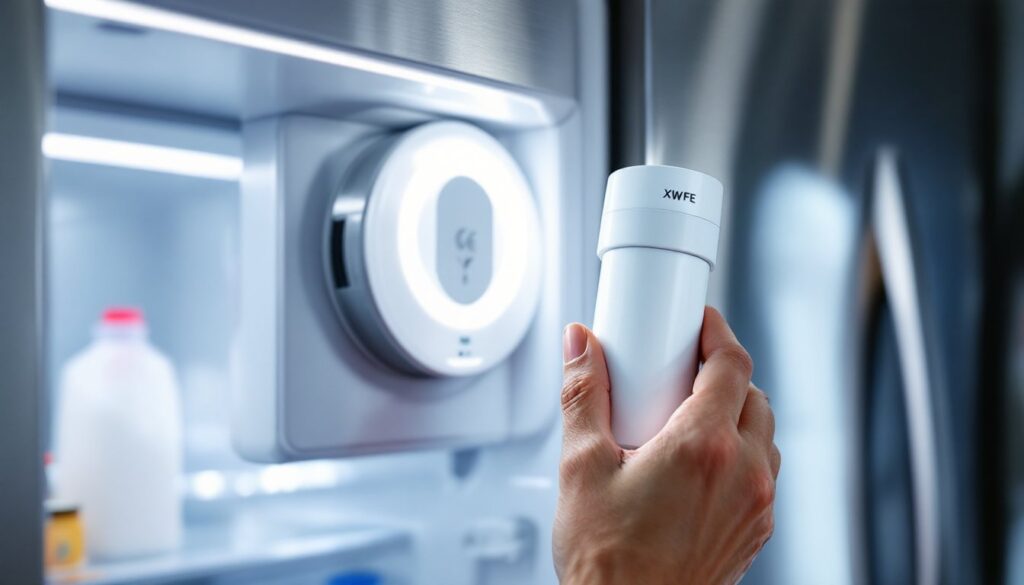
• XWFE: The current standard for most recent GE and GE Profile models (replaces the older XWF). Features RFID smart chip technology to track filter life.
• XWF: Found in many French door and side-by-side models from the mid-2010s.
• RPWFE: Required for select models with leak-sensing technology: these won’t accept older filters without an adapter.
• MWF: An older internal filter design still in use on some top-freezer and older side-by-side units.
• MSWF: Used in select compact and smaller capacity refrigerators.
Check your owner’s manual or the label inside the refrigerator (often on the ceiling or back wall of the fresh food compartment) for the correct filter part number. If you’ve lost the manual, the model and serial number sticker, usually on the interior side wall or behind the crisper drawer, lets you look up specs on GE Appliances’ website.
Identifying Your GE Refrigerator Model
The model number typically starts with letters like GFE, GNE, GSS, or PFE (Profile series). You’ll find it on a metal or foil sticker, often alongside the serial number.
Once you have the model number, cross-reference it with the appliance filter lookup tool or the manual. Many big-box stores and online retailers also let you search by model number to confirm compatibility. If you’re replacing an existing ge refrigerator water filter xwfe or other filter type, the part number is printed right on the old cartridge, just match it.
For ge side by side refrigerator water filter models, the filter is almost always in the upper-right corner of the fresh food compartment. French door models usually place it in the same spot, while bottom-freezer units sometimes install the filter in the base grille or inside the refrigerator.
Step-by-Step: How to Replace Your GE Water Filter
Swapping a ge refrigerator water filter replacement takes about two minutes and requires no tools. Here’s the standard process for internal cartridge filters (XWFE, XWF, RPWFE, MWF):
- Locate the filter housing. Open the refrigerator door and look in the upper-right corner of the fresh food section. You’ll see a round or rectangular cover.
- Remove the old filter. Twist the filter cartridge counterclockwise about a quarter turn (some models have a push-button release instead). Pull straight out. Expect a few drips, keep a towel handy.
- Prepare the new filter. Remove any protective caps or seals from both ends of the cartridge. Do not remove the RFID chip if present (XWFE and RPWFE models need it for filter life tracking).
- Install the new cartridge. Align the arrow or tab on the filter with the housing slot. Push in firmly, then twist clockwise until it locks. You’ll feel or hear a click.
- Flush the system. Run 3 to 4 gallons of water through the dispenser to clear trapped air and carbon fines. Discard this water, it’ll be cloudy or gritty at first.
- Reset the filter indicator light. Press and hold the Filter Reset button (location varies by model, check your manual) for 3 to 5 seconds until the light changes from red or yellow to green.
For base-grille filters (less common), the process is similar but accessed from the front kickplate. Twist or pull the filter straight out, then push the new one in until it clicks.
Safety note: If you have a ge profile refrigerator water filter replacement system with leak detection, only use RPWFE filters or an approved adapter. Using incompatible filters can trigger a leak alarm and shut off water flow.
How Often Should You Replace Your GE Water Filter?
GE recommends replacing ge refrigerator filters every six months, but that’s a guideline, not a hard rule. Actual lifespan depends on usage and water quality.
Replace sooner if:
• Water flow from the dispenser slows to a trickle.
• Ice cubes taste off, smell chlorinated, or appear cloudy.
• The filter indicator light turns red (most GE models track time, not gallons).
• You notice sediment or discoloration in dispensed water.
Heavy users, families filling multiple water bottles daily, making lots of ice, will hit the 300-gallon capacity faster. Conversely, a household that rarely uses the dispenser might stretch a filter to eight or nine months without issue, though stagnant water in the cartridge can grow bacteria, so don’t push it past a year.
Mark your calendar or set a phone reminder when you install a new water filter for ge refrigerator. Many people swap filters on predictable dates like New Year’s Day and the Fourth of July to stay on track.
Troubleshooting Common GE Water Filter Issues
Even after installing a new filter for ge refrigerator, problems can crop up. Here’s how to fix the most common ones:
Slow water flow or no water: Air pockets are the usual culprit right after installation. Dispense 3 to 4 gallons to purge air. If flow is still weak, check that the filter cartridge is fully seated and locked, an incomplete install restricts flow. Kinked or frozen water lines (if the fridge is too cold or near an exterior wall) can also block supply.
Filter indicator won’t reset: Hold the reset button longer, some models need up to 10 seconds. If the light stays red, the RFID chip may not be detected. Remove and reinstall the filter, making sure it clicks. Aftermarket filters without chips won’t reset the light on XWFE systems.
Leaking after filter change: Double-check the O-ring seal on the filter cartridge. If it’s damaged, twisted, or missing, water will leak. Remove the filter, inspect the rubber gasket, and reinstall. Genuine GE filters include a new O-ring on every cartridge.
Bad taste or odor persists: If you’ve flushed 4 gallons and water still tastes off, the filter may be counterfeit or defective. Also consider whether the issue is in your home’s plumbing rather than the fridge, run tap water to compare. Homes with hard water or high mineral content may need additional whole-house filtration.
Error codes (on smart models): Some newer GE Profile models display error codes if the filter isn’t recognized. Codes like “Replace Filter” or “Order Filter” are reminders. “Filter Error” usually means the RFID chip isn’t reading, reseat the cartridge or confirm you’re using an RPWFE filter if required.
Genuine GE Filters vs. Third-Party Alternatives
Genuine GE filters, sold under part numbers like XWFE, XWF, RPWFE, and MWF, cost roughly $40 to $60 each. Aftermarket filters run $15 to $30, often marketed as “compatible” or “comparable.”
The trade-off:
Genuine filters are NSF-certified, guaranteed to fit, and include RFID chips for filter life tracking on newer models. GE warranties may require genuine parts to stay valid. They’re tested to GE’s specs for flow rate, contaminant reduction, and cartridge integrity.
Third-party filters can offer significant savings and often carry NSF certifications of their own. But, quality varies widely. Cheaper filters may use lower-grade carbon, reducing contaminant removal or shortening lifespan. Cartridges without RFID chips won’t reset the filter light on XWFE systems, leaving a permanent red indicator (the fridge still works, but the reminder nags you). Some lack proper O-rings, causing leaks.
If you go third-party, stick with reputable brands that publish NSF test results and customer reviews. Check that the filter is explicitly listed as compatible with your model. Avoid no-name options from unfamiliar sellers, counterfeit filters occasionally surface online, and they can fail catastrophically or allow untreated water through.
For ge profile refrigerator filter systems with leak detection, only RPWFE or approved adapters work. Using a non-compatible filter triggers an error and shuts off water.
Bottom line: if your budget allows, genuine filters eliminate guesswork. If cost is tight, choose a well-reviewed aftermarket option with NSF certification and a solid return policy. Don’t gamble on your family’s water quality to save $10.