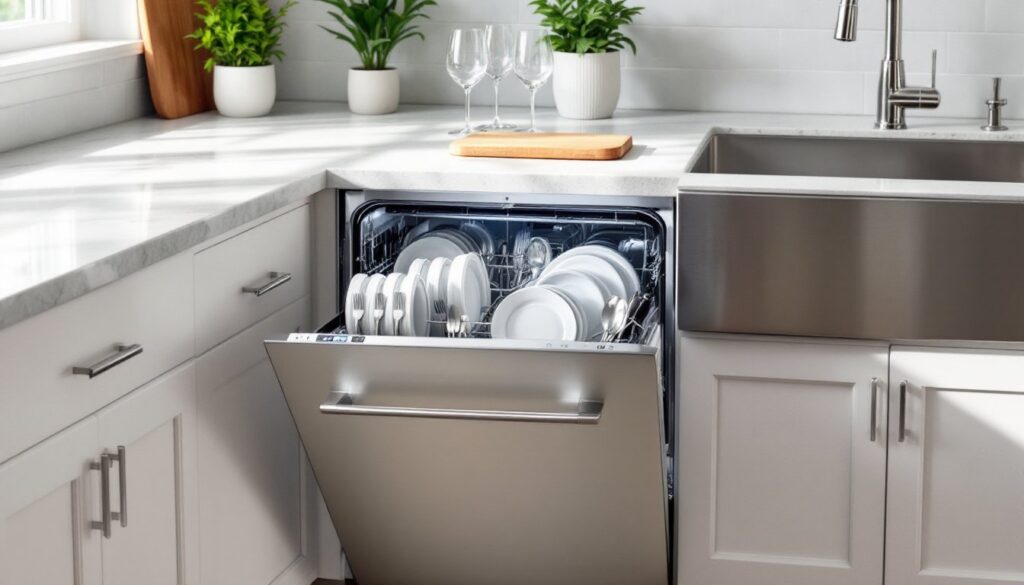
Kitchens keep shrinking while dish loads don’t. If you’re renovating a compact galley, outfitting a basement kitchenette, or just tired of a full-size dishwasher hogging cabinet space when you cook for one, a drawer dishwasher might be the answer. These dishdraw dishwasher units slide out like a filing cabinet, fit under standard 36″ countertops, and let you run small loads without wasting water or waiting for a full rack. Fisher & Paykel pioneered the design in the late 1990s, but today’s double drawer dishwasher models from brands like Bosch, KitchenAid, and Samsung pack serious cleaning power into a footprint half the size of traditional machines. In this guide, you’ll learn how drawer-style dishwashers work, when they make sense, and what to watch for during installation, whether you’re doing it yourself or hiring a plumber.
Table of Contents
ToggleKey Takeaways
- Drawer dishwashers fit under standard 36″ countertops in compact spaces, with single units holding ~6 place settings and double drawer dishwasher models offering ~12 place settings—ideal for households of three or fewer.
- A drawer dishwasher saves 1,000–1,500 gallons of water annually for small households by enabling efficient small-load cycles instead of wasting water on nearly empty runs.
- Installation requires careful cabinet measurements (tolerances as tight as ⅛”), proper plumbing with a ⅜” shut-off valve and braided stainless-steel supply line, and secure mounting to prevent tipping when the drawer opens.
- Premium features like adjustable racks, third spray arms, sanitize cycles, and Wi-Fi connectivity improve cleaning performance and convenience, but budget models starting at $700–$900 offer solid basic operation.
- Routine maintenance—weekly filter cleaning, vinegar treatment of latches, and greasing glide tracks—prevents common issues like poor drainage, sticking drawers, and cleaning performance problems.
What Is a Drawer Dishwasher and How Does It Work?
A drawer dishwasher is a pull-out appliance that mounts beneath your countertop and opens like a drawer instead of swinging down like a door. Most units are 24″ wide, the same as a standard dishwasher, but stand only 17–18″ tall, fitting neatly into a single base cabinet. You can buy a single drawer dishwasher or a double dishwasher stack (often called a 2 drawer dishwasher or two drawer dishwasher) that occupies the same 34–35″ height slot as a traditional model.
Mechanically, dishwasher drawers work just like their full-size cousins. A pump circulates hot water mixed with detergent through spray arms mounted in the bottom and sometimes the top of the tub. A filter traps food particles, and a heating element or condensation system dries the dishes. The difference is capacity: a single drawer holds about six place settings, enough for a couple or a day’s worth of prep dishes, while a dual dishwasher (two-drawer stack) handles roughly twelve place settings total.
Controls sit on the front panel or the top edge of the drawer. Most models offer multiple cycles (normal, heavy, quick, glassware) and adjustable racks with fold-down tines. Higher-end units include third spray arms, adjustable water pressure, and app connectivity. Because each drawer operates independently in a double-drawer setup, you can run a delicate cycle in the top drawer while the bottom sits idle, or queue both drawers on staggered start times to balance your electrical panel load during peak hours.
Key Benefits of Installing a Drawer Dishwasher
Flexible footprint. A single drawer fits in spaces a traditional dishwasher can’t: below a raised island bar, in a butler’s pantry, or tucked into an ADA-compliant lowered counter section. If you already have a standard dishwasher in the main sink run, adding a second drawer near the stove or beverage station cuts down on traffic during meal prep.
Water and energy savings. Running a full-size machine for three plates and a frying pan wastes about 4–6 gallons of water per cycle. A dishwasher with drawers lets you wash small loads as they accumulate, keeping your Energy Star rating honest. Over a year, that can shave 1,000–1,500 gallons off your bill if you’re a one- or two-person household.
Ergonomics. No more bending to the floor to load the bottom rack. Drawer-style units pull out at waist or chest height, which makes a real difference if you have back issues or mobility limits. This is one reason kitchen design experts increasingly recommend drawer appliances in universal-design renovations.
Independent operation in double-drawer models. A double drawer dishwasher functions as two separate machines. Wash your everyday dishes on a quick cycle in one drawer while saving the fine china or sticky pots for a heavier scrub in the other. This parallel workflow beats waiting for a single machine to finish.
Aesthetic integration. Panel-ready versions accept custom cabinet fronts, so the drawer disappears into your millwork. If you’re chasing a minimalist Scandi vibe or trying to match historic cabinetry, this seamless look is tough to beat.
Drawer Dishwasher vs. Traditional Dishwasher: Which Is Right for You?
Capacity. A standard 24″ dishwasher holds 12–16 place settings. A two-drawer unit matches the lower end of that range, but only if you’re running both drawers. If your family regularly generates more than twelve place settings at dinner plus pots, you’ll outgrow drawers fast. Households of three or fewer, or anyone who cooks in small batches, will find the capacity sufficient.
Cost. Single drawer units start around $700–$900: best 2 drawer dishwasher models run $1,200–$2,000. By comparison, a mid-range traditional dishwasher costs $600–$1,000, and premium models top out around $1,500. You’re paying a premium for modularity and the drawer mechanism, which uses more hinges, glides, and seals than a simple drop-down door.
Installation complexity. Both types need a 120V outlet, a ¾” hot-water supply line, and a drain connection to your sink’s tailpiece or garbage disposal. Drawer dishwashers often require more precise cabinet cutouts, tolerances can be as tight as ⅛” on each side, and the double-drawer stack is heavier (around 120–150 lbs fully assembled), so you’ll want help lifting it into place. Traditional dishwashers are more forgiving: shim the feet, level the unit, screw the mounting tabs to the underside of your countertop, and you’re done.
Repair access. Drawer mechanisms have more moving parts. Glides can gum up with grease, and the latch assemblies are proprietary. Parts availability improves each year, but some homeowners still report longer lead times than for traditional machines. Before buying, confirm your area has a certified service tech: appliance reviews often track warranty support by brand and region.
Noise. Modern drawer models measure 42–48 dB, on par with quiet traditional dishwashers. The drawer-glide sound is subtly different, a rolling hum instead of a hinge creak, but it won’t wake a light sleeper in an open-plan layout.
Top Features to Look for When Buying a Drawer Dishwasher
Adjustable racks and tines. Fold-down tines let you slot in sheet pans, mixing bowls, and tall stemware. The best single drawer dishwasher models include at least one adjustable rack height setting. Two-drawer units sometimes dedicate the top drawer to glassware with silicone-coated tines and the bottom to heavy cookware with reinforced spray.
Hard-food disposer vs. filtration system. A built-in disposer grinds soft food particles and flushes them down the drain: a filter-only system traps debris in a removable screen you rinse every few weeks. Disposers add $50–$100 to the price but reduce manual cleaning. If you pre-rinse dishes anyway, a simple filter is fine.
Sanitize and high-temp wash cycles. NSF/ANSI Standard 184 certifies that a dishwasher can reach 150°F final rinse temperature to kill 99.999% of bacteria. Useful if you wash baby bottles, cutting boards, or pet bowls. Not all drawer models offer this: check the spec sheet.
Third spray arm or PowerWash zones. Premium units mount an extra spinner in the top of the drawer or add targeted jets along the back wall. This matters if you load baking sheets flat or stack plates tightly. Budget models rely on a single lower arm, which can leave tall items in the “shadow.”
Smart connectivity. Wi-Fi-enabled drawers let you start, pause, or monitor cycles from your phone, receive detergent-low alerts, and download new wash programs. Home tech reviewers note that integration with Alexa, Google Assistant, or Apple HomeKit is improving, but firmware bugs still crop up. Weigh whether app control is worth $100–$200 extra.
Panel-ready design. If aesthetics trump convenience, panel-ready (also called integrated or overlay) models ship without a finished front. You or your cabinetmaker attach a ¾” door panel cut to match your existing cabinets. Handle placement and hinge style vary by brand: verify compatibility with your cabinet supplier before ordering.
Decibel rating. Anything below 45 dB is whisper-quiet: 46–50 dB is normal conversation level. Open-plan kitchens benefit from the quieter end of that spectrum, especially if your dishwasher runs overnight.
Installation Considerations and DIY Tips
Rough-in dimensions. Measure your cabinet opening’s width, height, and depth before ordering. A single drawer typically needs a 24″W × 17¾”H × 24″D space: a double-drawer stack requires 24″W × 34½–35″H × 24″D. Add ½” width clearance for side brackets and ¼” rear clearance for hoses.
Electrical. Most drawer dishwashers use a standard 120V, 15A circuit with a GFCI-protected outlet. The National Electrical Code (NEC) allows a dishwasher to share a 20A circuit with the garbage disposal, but local amendments vary, check your jurisdiction. If your existing outlet is behind the old dishwasher, confirm the cord length on the new unit (usually 4–6 feet) or plan to extend the wire inside the cabinet. Never use an extension cord.
Plumbing. You’ll need a ⅜” compression shut-off valve on your hot-water line (ideally under the sink) and a braided stainless-steel supply line long enough to reach the dishwasher inlet (typically on the bottom-left corner). The drain hose (usually ⅝” ID) connects to your sink tailpiece via an air gap or high loop to prevent backflow. If your local code mandates an air gap, mount it on the countertop or sink deck: the loop method is simpler but not permitted everywhere. Use a hose clamp and plumber’s grease on all connections: hand-tighten compression fittings plus one quarter-turn with a wrench.
Leveling and securing. Once the unit is in the opening, adjust the front feet until a bubble level reads true side-to-side and front-to-back. Secure the top of the unit to the underside of your countertop with the supplied brackets and screws, usually two per side for a single drawer, four for a double. This prevents tipping when the drawer is pulled out under load. Granite and quartz counters require special care: pre-drill pilot holes in the stone or use adhesive mounting pads instead of screws to avoid cracking.
First test run. With water and power connected, run an empty cycle on the heaviest setting. Check all hose connections for leaks, listen for unusual grinding (a sign the spray arm is hitting a rack), and verify the unit drains completely. If water pools in the bottom, the drain hose may be kinked or installed below the height of the sink trap, reroute it in a high loop.
Permit requirements. Most jurisdictions do not require a permit to replace an existing dishwasher on the same water, drain, and electrical connections. If you’re adding a new circuit or moving plumbing lines, pull permits. An inspector will verify GFCI protection, proper venting (if code requires an air gap), and secure mounting. Skipping permits can complicate your home sale or void appliance warranties.
Safety gear. Wear safety glasses when drilling into cabinetry or countertops, and cut-resistant gloves if you’re trimming metal water lines. Keep a bucket and towels handy to catch residual water when disconnecting the old machine.
Common Drawer Dishwasher Problems and How to Fix Them
Drawer won’t latch or open. The latch mechanism on dishwasher drawers includes a spring-loaded pin and a magnetic or mechanical catch. Over time, detergent residue and hard water can gum up the pin. Fix: Pull the drawer out fully and locate the latch housing (usually top-center of the drawer front). Wipe with a damp cloth dipped in white vinegar, then apply a drop of food-safe silicone lubricant. If the catch is broken, order the part by model number: replacement takes about 15 minutes with a Phillips screwdriver.
Poor cleaning performance. Dishes come out filmy or food stays stuck. Common causes: clogged spray arm, dirty filter, low water temperature, or wrong detergent. Fix: Remove the lower rack and unscrew the spray arm (turn counterclockwise). Rinse the arm under hot water and poke a toothpick through any clogged nozzles. Pull out the cylindrical or flat mesh filter and scrub with a soft brush. Check that your home water heater is set to at least 120°F. Finally, switch to a detergent formulated for hard water if you live in an area above 7 grains per gallon, test strips are cheap at any hardware store.
Drawer doesn’t drain completely. A small puddle remains in the sump after the cycle. Cause: Kinked drain hose, clogged air gap, or a failing drain pump. Fix: First, straighten the drain hose and ensure it loops above the sink trap height. Remove the air gap cap (if installed) and flush debris. If the problem persists, the drain pump may have a foreign object lodged in the impeller, consult your service manual for access and disassembly. This job typically requires removing the lower panel and disconnecting wire harnesses: if you’re not comfortable, call a tech.
Glide or roller issues. The drawer sticks, grinds, or derails when opening. Drawer dishwashers use ball-bearing glides or nylon rollers on metal tracks. Grease, detergent spills, or mineral deposits create friction. Fix: Fully extend the drawer and wipe the glide tracks with a degreaser (Simple Green or diluted dish soap). Dry thoroughly, then apply a thin bead of white lithium grease to the tracks, avoid WD-40, which attracts dust. Test the motion: if a roller is cracked, order a replacement from the manufacturer. Most rollers snap into brackets without tools.
Error codes and flashing lights. Modern drawers display fault codes on an LED panel or via blinking lights. Common codes include F1 (water-inlet failure), F2 (drain timeout), and F7 (heating element fault). Diagnosis: Consult the user manual’s code table. F1 usually means the inlet valve screen is clogged or the water shut-off is closed. F2 points to a drain blockage or pump issue. F7 can indicate a blown thermal fuse or a shorted element, both require meter testing and parts replacement. If you see multiple codes or persistent faults, the control board may be failing: replacement runs $150–$300 in parts plus labor.
Leaks around the door seal. Water pools under the unit after a cycle. The rubber gasket around the drawer perimeter can tear, harden, or collect debris. Fix: Inspect the gasket for cracks or missing sections. Clean the mating surface on both the drawer and cabinet frame with soapy water. If the seal is damaged, peel off the old gasket, clean any adhesive residue with isopropyl alcohol, and press a new seal into the channel (most are held by friction or a thin adhesive bead). Run a test cycle and check for leaks.
When to call a pro. Control-board diagnostics, pump motor replacement, and appliance-side electrical work are beyond typical DIY scope, especially if the unit is still under warranty. Attempting board-level repairs can void coverage. Likewise, if your local code requires a licensed plumber for any dishwasher work, respect that: the permit fee is cheaper than repairing water damage.
Conclusion
Drawer dishwashers trade raw capacity for flexibility, ergonomics, and efficient small-load washing. They shine in compact kitchens, secondary prep zones, and homes where bending to load a traditional machine is a dealbreaker. Installation follows familiar plumbing and electrical steps, but tighter cabinet tolerances and heavier double-drawer stacks mean careful measuring and an extra pair of hands. Once in place, routine filter cleaning and occasional glide maintenance keep these units running smoothly for a decade or more. If your dish load and budget align, a best 2 drawer dishwasher or even a single-drawer unit can reshape how you use your kitchen, one pull-out tray at a time.